


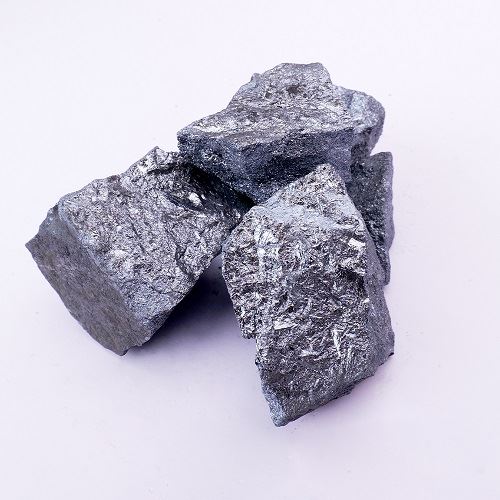


Ferro Silicon Supplier
Products Description
Ferro Silicon (FeSi) is a vital ferroalloy composed primarily of iron and silicon, widely used in the steel and foundry industries. Its primary function is to act as a deoxidizer, alloying agent, and nodularizer in various metallurgical applications. By improving the strength, hardness, and corrosion resistance of steel, Ferro Silicon plays a key role in enhancing product quality and performance in steelmaking and cast iron manufacturing.
Specification
| Grade | Si (%) | Al (%) max | C (%) max | S (%) max | P (%) max | Size Options |
|---|---|---|---|---|---|---|
| FeSi 75 | 75±1 | 1.5 | 0.2 | 0.02 | 0.04 | 10–50mm, 10–100mm |
| FeSi 72 | 72±1 | 2.0 | 0.2 | 0.02 | 0.04 | 10–50mm, 10–100mm |
| FeSi 65 | 65±1 | 2.5 | 0.2 | 0.02 | 0.04 | 10–50mm, 10–100mm |
| FeSi Granules | 45–60 | 2.0 | 0.2 | 0.02 | 0.04 | 1–3mm, 3–10mm (granular form) |
Characters (Key Features)
✅ Strong Deoxidizing Effect – Enhances steel purity and prevents oxide inclusions.
✅ Excellent Thermal Stability – Performs well under high-temperature conditions.
✅ Corrosion & Abrasion Resistance – Improves the durability of final products.
✅ Improves Castability – Increases fluidity and reduces shrinkage in casting.
✅ Customizable Composition – Tailored to meet specific steelmaking requirements.

Why Choose Factory-Direct Ferro Silicon?
Stable Quality Assurance – Direct from the source with strict production control.
More Competitive Prices – Eliminate middlemen to reduce your material costs.
Faster Delivery Times – Reliable logistics and direct shipment from plant.
Flexible Order Quantities – Support for both bulk and small-batch buyers.
Technical Support – Direct access to manufacturer's knowledge and after-sales service.
When you source factory-direct, you're not just buying Ferro Silicon - you're gaining a production partner.
What is the Typical Silicon Content in Ferro Silicon?
The typical silicon content in Ferro Silicon ranges from 65% to 75%, depending on the grade. The most commonly used grades are:
FeSi 75% – Preferred in high-quality steelmaking and alloy production.
FeSi 72% – Cost-effective option for general steel and foundry applications.
FeSi 65% – Used in applications where slightly lower silicon content is acceptable.
The choice of silicon content depends on the end-use and desired metallurgical properties.
Case Study
Background
A mid-sized specialty steel mill in the Midwest, producing 1.2 million tons annually of spring steel and wear-resistant plates, faced a recurring profitability challenge. Their existing supply chain for Ferro Silicon (FeSi) – a critical deoxidizer and alloying agent – was marked by erratic quality, inconsistent delivery schedules, and a pricing model that failed to reflect market volatility. The mill's melt shop was experiencing a 4.2% rejection rate on finished coils due to hydrogen-induced porosity and silicate inclusions, directly traced to fluctuating silicon recovery rates from their FeSi feedstock.
The Problem
The incumbent supplier provided FeSi in 50-mm lump form with a stated specification of 75% minimum silicon. However, internal sampling revealed significant batch-to-batch variation, with actual silicon content ranging from 71% to 74%. This forced the metallurgists to over-add FeSi by 8–10% per heat to guarantee target chemistry, wasting roughly $180,000 annually in raw material costs. Furthermore, the lump's high fines content (12% under 5 mm) led to rapid oxidation during ladle addition, reducing effective yield from 92% to 86%.
Logistically, the supplier's reliance on barge transport during spring thaw caused two unplanned shutdowns in the previous year, costing over $400,000 in lost production and restart energy penalties.
The Solution
The mill initiated a rigorous 14-week supplier re-evaluation. The new sourcing strategy focused on three non-negotiable pillars: chemical consistency, physical form optimization, and supply chain agility.
Specification Redesign: Instead of accepting a generic 75% grade, the mill mandated a narrow-band specification of 75.5% ± 0.3% Silicon, with strict caps on Aluminum (under 1.2%) and Titanium (under 0.05%) to prevent nozzle clogging in continuous casters.
Product Form Shift: The team transitioned from standard lump to crushed and screened (-10+50 mm) FeSi with a certified fines content under 3%. This ensured faster, more complete dissolution in the molten bath and improved recovery predictability.
Supplier Proximity: They onboarded a supplier with a domestic processing plant located within 200 miles, replacing water transport with truck-based JIT (Just-In-Time) delivery, guaranteed within a 4-hour window.
Implementation
The transition was phased over two months. The new supplier provided a full chemical spectrograph for each batch, alongside a Certificate of Analysis (COA) transmitted 48 hours prior to shipment. The mill's melt shop adjusted their adding protocol: the finer, uniform granulation allowed for a 6% reduction in average FeSi weight per heat while maintaining target silicon levels. Simultaneously, the logistics team integrated the supplier's shipping API into their own ERP system, enabling real-time tracking.
Results Achieved (12-Month Post-Implementation Data)
| Metric | Pre-Change (Baseline) | Post-Change | Improvement |
|---|---|---|---|
| Average Silicon Recovery Rate | 86.2% | 93.5% | +7.3% |
| Grade Rejection Rate (Inclusions) | 4.2% | 1.1% | -74% |
| FeSi Consumption per Ton Steel | 11.4 kg | 9.8 kg | -14% |
| Unplanned Production Stoppages | 2 per year | 0 | 100% elimination |
| Annual FeSi Material Cost | $2.1M | $1.82M | $280,000 saved |
Conclusion
By moving beyond price-per-ton and focusing on functional performance, the steel mill transformed its Ferro Silicon from a volatile expense into a stabilized process enabler. The increased recovery rate alone added 150 tons of effective silicon per year without increasing raw purchases. The elimination of unscheduled downtime improved furnace relining intervals by extending campaign life.
This case demonstrates that for high-quality steelmakers, the "cheapest" FeSi is rarely the most cost-effective. A partnership model emphasizing tight tolerances, consistent particle sizing, and responsive logistics delivers a clear ROI – reducing total manufacturing cost by an estimated $18 per finished ton, while simultaneously improving the cleanliness and ductility of the final steel product. The project was subsequently replicated across the mill's sister plant in the Pacific Northwest.
Hot Tags: Ferro Silicon Supplier, China Ferro Silicon Supplier manufacturers, suppliers, factory, ferro silicon for solar energy, ferro silicon for nuclear energy, ferro silicon for wholesale, ferro silicon for emergency orders, ferro silicon for logistics, ferro silicon for electrical industry
Previous
Ferro Silicon 70You Might Also Like


Send Inquiry