

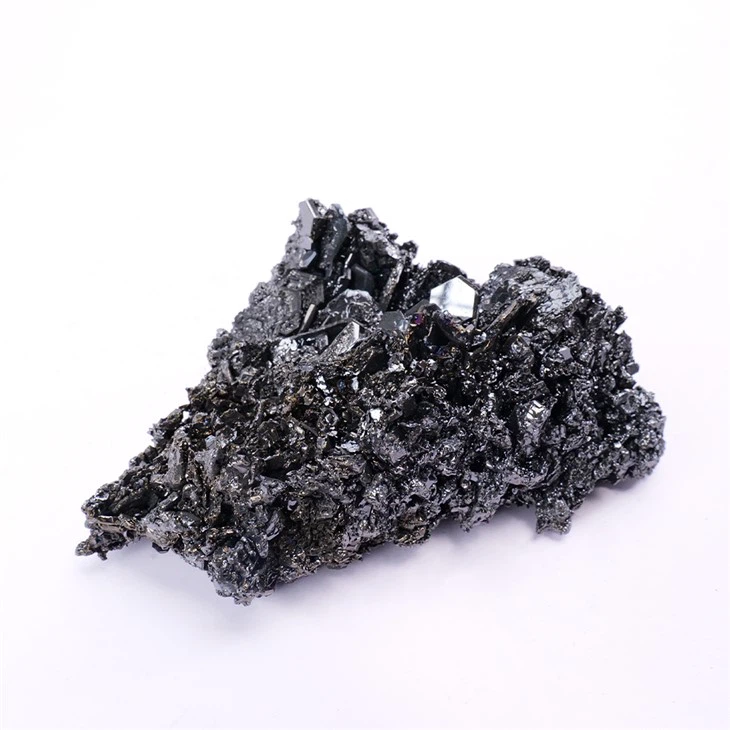


Products Description
Black silicon carbide is a synthetic compound made by heating silica sand and petroleum coke in an electric resistance furnace at 2,200°C (4,000°F). The result is a dark, crystalline material with:
Key Properties of Black SiC ⚡
✔ Extreme Hardness (9.5 Mohs) – Just below diamond.
✔ High Thermal Conductivity – Efficient heat dissipation.
✔ Chemical Resistance – Withstands acids and alkalis.
✔ Brittle & Sharp Fracture – Ideal for abrasive applications.
✔ Cost-Effective – Cheaper than green SiC but still highly durable.
How It Differs from Green Silicon Carbide
| Property | Black SiC | Green SiC |
|---|---|---|
| Purity | ~98% SiC | ~99% SiC |
| Hardness | Slightly lower | Higher |
| Cost | Lower | Higher |
| Applications | Abrasives, refractories | Precision grinding, electronics |
How Black Silicon Carbide Is Made
1. Raw Materials
Silica sand (SiO₂)
Petroleum coke (C)
Sawdust (helps with porosity)
2. The Acheson Process
Mixing – Raw materials are blended.
Furnace Heating – Heated to 2,200°C in an electric arc furnace.
Crystallization – Forms large SiC crystals.
Crushing & Grading – Processed into grains or powder.
This method produces coarser, less pure crystals than green SiC but at a lower cost.
Top Applications of Black Silicon Carbide
1. Abrasives & Grinding Tools
Grinding wheels – Used for metals, ceramics, and stone.
Sandblasting media – Cleans and prepares surfaces.
Cutting tools – Ideal for tungsten, titanium, and cast iron.
Why? Its sharp edges and hardness make it perfect for material removal.
2. Refractories & Foundry Use
Furnace linings – Resists extreme heat (up to 1,600°C).
Steelmaking additives – Enhances metal strength.
Ceramic composites – Used in kiln furniture.
Why? High thermal shock resistance prevents cracking under rapid temperature changes.
3. Automotive & Aerospace Components
Brake discs & pads – Improves wear resistance.
Turbine parts – Withstands high-stress environments.
Why? SiC's durability extends component lifespan.
4. Electronics & Semiconductors
High-voltage devices – Used in power electronics.
LED heat sinks – Efficient thermal management.
Why? Even at lower purity, black SiC aids in heat dissipation.
5. Wear-Resistant Coatings
Pump seals – Reduces friction and corrosion.
Mining equipment – Extends machinery life.
Why? Its hardness prevents erosion in harsh conditions.
Advantages of Black SiC Over Other Abrasives
| Material | Hardness (Mohs) | Thermal Conductivity | Cost |
|---|---|---|---|
| Black SiC | 9.5 | High | $$ |
| Aluminum Oxide | 9.0 | Medium | $ |
| Diamond | 10 | Very High | $$$$ |
| Boron Carbide | 9.3 | Medium | $$$ |
Why Choose Black SiC?
✅ More affordable than diamond or boron carbide.
✅ Harder than aluminum oxide.
✅ Better heat resistance than most abrasives.
Challenges & Limitations of Black SiC ⚠️
Despite its strengths, black silicon carbide has some drawbacks:
Brittleness – Can fracture under heavy impact.
Lower Purity – Not ideal for high-end semiconductor use.
Dust Hazards – Requires proper handling (can cause silicosis).
Solution: Proper safety gear and using bonded abrasives minimize risks.
Future Trends in Black Silicon Carbide
1. Recycling & Sustainability ♻️
Reclaimed SiC from used abrasives is gaining traction.
Eco-friendly production methods reduce energy consumption.
2. Advanced Composites 🧪
SiC-reinforced ceramics for armor and aerospace.
3D-printed SiC parts for custom industrial tools.
3. Growing Demand in EVs & Renewable Energy ⚡
More efficient power modules using SiC.
Wind turbine coatings for longer durability.
Hot Tags: black silicon carbide, China black silicon carbide manufacturers, suppliers, factory


