


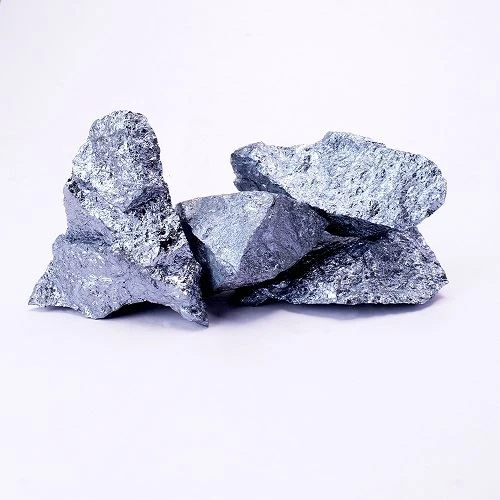


Silicon Metal SIC 553
Unveiling the Versatility of Silicon Metal 553
Silicon metal 553 is a specific grade of silicon metal used in industrial applications. It typically contains around 99.5% pure silicon, with small amounts of other elements like iron and aluminum. This grade is commonly used in the production of aluminum alloys and in the chemical industry. Its high purity makes it suitable for various manufacturing processes where silicon is a key component.
Silicon metal typically comes in the form of lumps, chunks, or powder. The exact shape depends on the manufacturing process and intended use.
The composition of metal silicon is mainly silicon, so it has similar properties to silicon. The properties of metal silicon are similar to those of germanium, lead and tin, and have semiconductor properties.
Silicon Metal Category
The classification of metal silicon is usually classified according to the content of three main impurities of iron, aluminum and calcium contained in the metal silicon component. According to the content of iron, aluminum and calcium in metal silicon, metal silicon can be divided into 553, 441, 411, 421, 3303, 3305, 2202, 2502, 1501, 1101 and other different grades.

Silicon Metal 553 Usage
Alloy Production:
Silicon Metal 553 serves as a crucial additive in non-ferrous alloys, enhancing their strength and durability. It's particularly valuable in creating silicon steel, a material prized for its magnetic properties and used extensively in electrical transformers and motors.
Steel Manufacturing:
In the steel industry, Silicon Metal 553 acts as a powerful deoxidizer. It helps remove excess oxygen during the smelting process, improving the quality of special steel grades and non-ferrous alloys.
Electronics Industry:
Through advanced purification processes, industrial silicon can be refined into monocrystalline silicon – a high-purity form essential for manufacturing semiconductors, solar cells, and other electronic components.
Silicone Production:
Silicon Metal 553 is a key ingredient in manufacturing various silicone products, including silicone rubber, resins, and oils. These materials find use in countless applications, from cookware and sealants to medical devices and aerospace components.
Chemical Industry:
In organic chemistry, Silicon Metal 553 serves as a starting material for synthesizing various silicon-based compounds used in lubricants, water repellents, and even some pharmaceuticals

Silicon Metal 553 Characteristics
- Appearance: Silvery-gray color with a metallic luster
- Brittleness: Hard but brittle material
- Melting point: High, around 1414°C (2577°F)
- Electrical conductivity: Semiconductor properties
- Chemical reactivity: Relatively inert at room temperature
- Thermal conductivity: Good conductor of heat
- Density: Lighter than most metals, about 2.33 g/cm³
How To Choose High Quality Metal Silicon
Purity level: Higher purity (99.5% or above) is generally better.
Impurity content: Lower levels of impurities like iron, aluminum, and calcium are preferable.
Particle size: Should match your specific application needs.
Consistency: Uniform composition across batches.
Supplier reputation: Choose reputable manufacturers with good quality control.
Certification: Look for products that meet industry standards.
Intended use: Ensure the grade matches your specific application requirements.
Physical appearance: Should have a consistent, metallic gray color.
Trace element profile: Some applications may require specific trace element compositions.
Price: While not always indicative of quality, extremely low prices may suggest lower quality.
Case Study
Precision Aluminum Automotive Parts Manufacturer in Baden-Württemberg, Germany
Customer Profile & Operational Context:
This Tier-1 supplier to German luxury automakers produces complex aluminum-silicon alloy components, including engine blocks, cylinder heads, and pistons for high-performance vehicles. Their manufacturing process relies on A356 and A319 aluminum alloys, which require precise silicon content (typically 7-12%) to achieve optimal castability, wear resistance, and thermal stability . Operating a battery of medium-frequency induction furnaces with a daily throughput of approximately 120 tons of molten aluminum, the foundry serves as a critical link in the European automotive supply chain.
Initial Challenge & Technical Pain Points:
The manufacturer faced persistent quality inconsistencies that threatened their just-in-time delivery commitments to multiple automotive OEMs. Specific challenges included:
Silicon Recovery Variability: The silicon metal they were sourcing exhibited inconsistent dissolution behavior, with recovery rates fluctuating between 82% and 91% across different production batches. This unpredictability forced metallurgists to routinely overshoot silicon targets and then dilute with primary aluminum, creating inefficiency.
Iron Contamination Issues: Periodic spikes in iron content (exceeding 0.15% in finished alloy) were traced back to impurities in their silicon metal feedstock. For critical safety components like high-pressure die-cast engine blocks, iron acts as a brittle intermetallic former, increasing rejection rates during X-ray inspection.
Segregation Problems: The particle size distribution of their previous silicon metal supplier ranged too widely (from fine dust to oversized lumps >100mm). Fine material oxidized before dissolution, while oversized lumps sank to furnace bottom, creating localized silicon-rich zones and inconsistent melt chemistry.
Extended Furnace Cycle Times: To compensate for these variables, the melt shop extended holding and stirring cycles by an average of 22 minutes per heat, increasing energy consumption and reducing overall production capacity.
Our Technical Solution & Implementation:
Following an on-site metallurgical audit, our technical team developed a comprehensive solution package:
1. Customized Product Specification:
We supplied Premium Aluminum-Grade Silicon Metal (Grade 553) with guaranteed chemistry: Si 98.8% min, Fe 0.35% max, Al 0.40% max, Ca 0.10% max. This tight impurity profile, particularly the low iron specification, directly addressed their contamination concerns.
2. Optimized Particle Size Distribution:
Based on their furnace type and addition practice, we engineered a 10-50 mm screened lump size with strict controls:
Minimal fines (<5 mm): Less than 3% to prevent oxidation loss
Oversized material (>80 mm): Less than 2% to ensure consistent melting
Uniform mid-range (10-50 mm): Minimum 90% for predictable dissolution kinetics
3. Process Integration Support:
Our metallurgists worked with their production team to refine the addition protocol:
Recommended addition timing: Mid-melt cycle, after initial scrap melt but before final superheating
Optimized stirring parameters: Reduced electromagnetic stirring intensity to prevent vortexing that previously drew fine material into the dross layer
Temperature control guidelines: Addition at 720-750°C for maximum recovery without excessive oxidation
4. Quality Assurance Protocol:
We established a lot-by-lot certification system with:
Pre-shipment sampling and analysis from our production facility
QR-coded documentation linking each delivery to specific cast numbers
Quarterly statistical process control reports tracking consistency against their specifications
Measurable Results & Value Delivered:
Metallurgical Consistency:
Silicon recovery stabilized at 94-96% across all production runs, eliminating the need for compensatory additions
Iron content in finished alloy remained consistently below 0.12%, reducing casting rejections by 67%
Microstructural analysis confirmed uniform silicon distribution throughout cast components
Operational Efficiency:
Average furnace cycle time reduced by 18 minutes per heat, increasing daily production capacity by approximately 8%
Energy consumption per ton of molten alloy decreased by 11% due to reduced holding and stirring requirements
Dross generation reduced by approximately 15%, lowering both material loss and disposal costs
Quality Metrics:
Casting rejection rate due to silicon-related defects dropped from 4.2% to 1.1% over six months
Zero instances of silicon segregation detected in X-ray inspection of safety-critical components
Customer passed their ISO/TS 16949 surveillance audit with improved raw material traceability scores
Long-Term Partnership Evolution:
Following the successful implementation, the relationship expanded to include:
Sole-supplier status for all silicon metal requirements across three production facilities
Joint development program for next-generation high-silicon alloys (Al-Si 17-20%) for electric vehicle battery housing applications
Quarterly technical review meetings to continuously optimize addition practices
This case demonstrates how precise silicon metal specification, tailored to specific process conditions, transforms a commodity raw material into a strategic enabler of manufacturing excellence.
Hot Tags: silicon metal sic 553, China silicon metal sic 553 manufacturers, suppliers, factory, Ferro Chrome, Ferro Silicon Barium Fesiba, Other Ferro Alloy, Silicon Carbon Alloy, Silicon Manganese, Silicon Series
You Might Also Like


Send Inquiry