Can Silicon Carbon Replace Ferro Silicon and Carbon Raiser Simultaneously?
In the steelmaking and foundry industries, efficiency and cost reduction are perpetual goals. Traditionally, when producing steel in an Electric Arc Furnace (EAF) or a Ladle Furnace (LF), metallurgists add Ferro Silicon (FeSi) for deoxidation and a separate Carbon Raiser (such as Graphite, Calcined Petroleum Coke) to adjust the carbon content of the molten steel.
Silicon Carbon (Si-C) alloy has emerged as a popular composite material that claims to perform both functions. But can it truly replace these two traditional materials at the same time?
The short answer is yes, in most conventional steelmaking and iron casting processes, Silicon Carbon can effectively replace the combination of Ferro Silicon and Carbon Raiser. However, there are specific technical considerations to keep in mind.
How Silicon Carbon Works as a Duo-Role Material
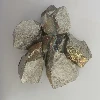
Silicon Carbon is typically a by-product of the silicon metal industry or a specifically engineered alloy. It contains both metallurgical silicon (Si) and fixed carbon (C) in a single particle.
The Silicon Role (Deoxidation):
When added to molten steel, the silicon in the Si-C alloy has a high affinity for oxygen. It reacts with the dissolved oxygen (FeO) in the steel to form silicon dioxide (SiO2), which floats up into the slag. This cleans the steel.
2FeO+Si→2Fe+SiO2(Slag)2FeO+Si→2Fe+SiO2(Slag)
The Carbon Role (Carburization):
Simultaneously, the carbon content in the alloy dissolves into the molten iron. This increases the overall Carbon equivalent in the steel, which is essential for achieving the desired mechanical properties like strength and hardness.
Advantages of Replacing FeSi + Carbon Raiser with Si-C
Cost Efficiency:
This is the primary driver. Silicon Carbon is generally cheaper than the combined cost of high-purity Ferro Silicon and high-quality Graphite/CPC. By using one material to do the job of two, steel mills can significantly reduce their alloy addition costs per ton of steel.
Synergistic Absorption:
In many cases, the presence of silicon can actually improve the absorption rate of carbon. The silicon lowers the melting point of the material, allowing it to dissolve more rapidly and evenly in the molten bath, potentially reducing yield loss compared to adding dense carbon raisers alone.
Simplified Logistics and Handling:
Managing one type of material instead of two reduces storage space requirements, simplifies weighing and batching at the furnace, and lowers the risk of using the wrong material.
Limitations and Considerations
While Si-C is highly effective, it is not always a perfect 1:1 replacement in every scenario. There are two main factors to consider:
Precision of Chemistry (The "Tuning" Factor):
Ferro Silicon (FeSi) usually has a guaranteed high silicon content (65%, 72%, or 75%) with minimal impurities.
Carbon Raisers usually have very high carbon (98%+) and very low sulfur and nitrogen.
Silicon Carbon is a mixture. A typical grade might be Si50% C15%. If your steel recipe requires exactly 0.60% Carbon and 0.30% Silicon from your additions, using Si-C means you are adding these elements in a fixed ratio. If your bath chemistry deviates, you cannot adjust Silicon without also adjusting Carbon (or vice versa) using this material alone. For final "trimming" adjustments, you might still need pure FeSi or pure Carbon Raiser.
Nitrogen and Sulfur Content:
High-quality steel grades (like those for deep-drawing automotive sheets) have strict limits on Nitrogen. Some carbon raisers are specifically calcined to be low in Nitrogen. Depending on the source of Silicon Carbon, it may introduce higher levels of impurities (Al, Ca, N) compared to using separate, high-purity materials.

When is it Best to Use Si-C?
General Carbon Steel: For common carbon steel grades (like rebar, sections, and structural steel), Silicon Carbon is an excellent, cost-effective substitute.
Roughing Stage: In the EAF during the initial melting stage, adding bulk Silicon Carbon is very efficient.
Foundry Applications: In iron foundries, Silicon Carbon is widely used to adjust the Carbon Equivalency in ductile and grey iron.
Conclusion
For the vast majority of applications aimed at reducing costs and simplifying operations, Silicon Carbon can indeed replace Ferro Silicon and Carbon Raiser simultaneously.
It serves as an excellent bulk deoxidizer and carburizer. However, for high-end steel grades requiring precise final chemistry or extremely tight impurity controls (specifically Nitrogen and Sulfur), it is often used as a partial replacement (for bulk addition in the EAF) while reserving high-purity FeSi and special carbon raisers for the final "trimming" stage in the Ladle Furnace.
If your goal is to reduce the cost per ton of liquid steel, testing a batch of Silicon Carbon in your current process is a recommended first step.