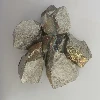
Silicon barium contributes to significant cost savings in metallurgical processes through a combination of enhanced efficiency, reduced consumption of other materials, and improved final product quality. Its primary economic benefits can be broken down into the following areas:
1. Enhanced Deoxidation and Desulfurization Efficiency
Silicon barium acts as a powerful compound deoxidizer and desulfurizer. The barium component creates stable, easily removable oxides and sulfides. This means that silicon barium achieves cleaner steel with lower oxygen and sulfur content more quickly and with less additive mass compared to using ordinary ferrosilicon or silicon metal alone. This efficiency directly translates to lower consumption of deoxidizing agents per ton of steel, reducing raw material costs.
2. Reduced Consumption of More Expensive Alloys
A key cost-saving mechanism of silicon barium is its ability to partially replace other, often more costly, additives. Due to its strong inoculation effect in cast iron and its ability to modify non-metallic inclusions in steel, the use of silicon barium can reduce the required dosage of pure calcium, calcium silicide, or rare earth elements. Since these materials are typically more expensive, strategic use of silicon barium creates a favorable cost balance.
3. Improved Alloy Yield and Reduced Losses
The barium in silicon barium increases the recoveries (yields) of key elements like silicon, calcium, and aluminum in the melt. By forming less volatile and more stable reaction products, silicon barium minimizes the loss of these valuable elements to the slag or atmosphere. This improved yield means less additive is needed to achieve the target chemistry, again reducing material costs and improving process consistency.

4. Energy and Operational Savings
By promoting faster and more effective slag formation and improving fluidity, silicon barium can shorten treatment times during refining. A more efficient process cycle reduces total energy consumption (kWh/ton) in electric arc furnaces or ladle furnaces. Furthermore, cleaner steel from using silicon barium can reduce downstream processing issues and rework, saving on operational costs.
5. Extended Refractory Lining Life
The superior deoxidation provided by silicon barium leads to a reduction in aggressive, oxidizing slag. This less corrosive environment decreases the wear and tear on furnace and ladle refractory linings. Consequently, silicon barium contributes indirectly to cost savings by extending the campaign life of linings, lowering maintenance frequency, and reducing refractory material costs per ton of output.
6. Improved Final Product Quality and Yield
In casting applications, silicon barium is an excellent inoculant, promoting the formation of a uniform, fine graphite structure. This results in fewer casting defects (like shrinkage porosity), improved machinability, and higher mechanical properties. Higher product yield and reduced scrap rates are major sources of cost avoidance, and silicon barium plays a direct role in achieving this.
In summary, silicon barium is not merely a source of silicon; it is a multifunctional, efficiency-boosting additive. The cost savings from using silicon barium are holistic, stemming from its direct chemical efficiency, its role as a substitute for premium alloys, its positive impact on operational parameters, and its contribution to higher final product quality and yield.
📧E-mail: goldenltd.silicon@gmail.com 📞WhatsApp: http://wa.me/8616663721147