How Is Ferro Silicon Slag Produced?
Ferro silicon slag is not a primary product of the metallurgical industry but rather a by-product generated during the smelting of ferro silicon alloys. To understand its production, one must first grasp the basic process of manufacturing ferro silicon itself, because the slag forms as a secondary material in that same furnace operation. The production of ferro silicon slag is inherently tied to the reduction of quartz (silica) with carbonaceous materials in the presence of iron, typically carried out in submerged electric arc furnaces. The slag that floats on top of the molten alloy is subsequently tapped, cooled, and processed, yielding a material that is rich in silicon dioxide and metallic values.
The production sequence begins with the preparation of the furnace charge. Raw materials include quartz or silica rock as the source of silicon, petroleum coke or coal as the reducing agent, and steel scrap or iron ore to supply the iron content. These materials are carefully weighed and mixed to achieve the desired alloy grade, typically 75% or 65% silicon. The charge is then fed continuously into the submerged arc furnace, where electrodes deliver high-intensity electrical energy. The heat generated-reaching temperatures above 2,000°C-initiates the reduction reaction: silica is reduced by carbon to form silicon, while carbon monoxide gas is released as a by-product. The molten silicon combines with the iron to form ferro silicon, which settles at the bottom of the furnace due to its higher density.
Meanwhile, the impurities present in the raw materials do not participate in the reduction reaction. These include alumina, lime, magnesia, and unreacted silica, which melt and form a separate liquid layer above the heavier ferro silicon alloy. This upper layer is the ferro silicon slag. Its chemical composition varies depending on the quality of the ores and fluxes used, but it generally contains 40% to 60% silicon dioxide, along with significant amounts of aluminum oxide, calcium oxide, and iron oxides. Some metallic silicon and ferro silicon particles are also mechanically entrapped in the slag, which gives it economic value for secondary applications.

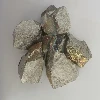
Once the smelting cycle is complete, the furnace is tapped through a taphole. The molten ferro silicon alloy flows out first, directed into casting molds or a launder system for granulation. Following the alloy, the slag is tapped separately into slag pots or pits. At this stage, the slag is still in a liquid state at temperatures around 1,500°C to 1,600°C. It is allowed to cool slowly in air, which promotes crystallization and the formation of large, dense lumps, or it may be water-quenched to produce a friable, glassy granular material. The choice of cooling method affects the slag's physical properties and downstream processing ease.
After solidification, the ferro silicon slag undergoes primary crushing and screening to separate it from any residual metallic ferro silicon that may have settled during cooling. Magnetic separation is often employed to recover the entrained alloy, which is returned to the furnace for re-melting. The remaining slag, now depleted of most recoverable metal, is further crushed and sized into various fractions. These processed slag products are then sold for uses such as deoxidizers in steelmaking, cover materials in ladle metallurgy, or as raw material for manufacturing ceramic and abrasive products. In essence, the production of ferro silicon slag is an inevitable consequence of ferro silicon alloy manufacturing, and its generation is optimized not by design but by the thermodynamic and compositional constraints of the electric arc furnace process. The entire operation is carefully controlled to balance alloy quality, energy efficiency, and the economic recovery of valuable components from the slag itself.
📧E-mail: goldenltd.silicon@gmail.com 📞WhatsApp: 86 166 6372 1147