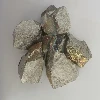
In the secondary metallurgy and steelmaking processes, ferro silicon is one of the most widely used deoxidizers due to its strong affinity for oxygen and its cost-effectiveness. However, many production managers tend to focus solely on chemical composition while overlooking a critical physical parameter-lumpy size. In practice, the particle size distribution of ferro silicon directly determines dissolution rate, recovery yield, and slag-metal reaction kinetics. Adjusting lumpy size is not a mere logistical choice; it is a process engineering tool that can significantly enhance deoxidation efficiency.
The Mechanism of Lumpy Size on Dissolution Kinetics
The deoxidation reaction between ferro silicon and molten steel is heterogeneous and occurs at the interface between the solid alloy and the liquid metal. According to the shrinking core model, the dissolution rate is inversely proportional to the square of the particle radius. Smaller lumps provide a greater specific surface area per unit mass, allowing heat transfer from the molten bath to penetrate the alloy more rapidly. This accelerates melting and promotes early formation of liquid silicon-rich zones, which are essential for the subsequent precipitation deoxidation reaction: Si + 2[O] → (SiO₂). Conversely, oversized lumps (>80 mm) tend to float on the slag layer, partially oxidizing at the slag-air interface before they can dissolve, leading to a delayed deoxidation effect and increased silicon loss.
Balancing Recovery Yield and Reaction Safety
While fine particles (<10 mm) dissolve almost instantaneously, they are not without drawbacks. Ultra-fine fines are prone to entrainment in the furnace off-gas system or re-oxidation during tapping, reducing the effective recovery rate. Moreover, an excessively rapid dissolution of fine particles can generate a concentrated local exothermic effect, intensifying bath turbulence and increasing the risk of ladle glaze erosion. On the other hand, excessively large lumps (>100 mm) suffer from a "skin effect": a molten outer shell forms while the inner core remains solid, causing a delayed release of silicon that misses the optimal deoxidation window. Therefore, the optimal lumpy size is not a single fixed value but a balanced range, typically 20–60 mm for most conventional ladle furnaces, depending on bath volume and stirring energy.

Adjustment Strategies for Different Process Stages
For practical optimization, ferro silicon lumpy size should be tailored according to the deoxidation stage:
Pre-deoxidation during tapping: Use moderately sized material (40–70 mm) to ensure deep penetration into the steel stream, providing a sustained release of silicon as the ladle fills.
Final adjustment in ladle furnace (LF) treatment: Apply finer fractions (15–35 mm) combined with argon stirring to achieve rapid fine-tuning of dissolved oxygen, ensuring a stable aluminum-silicon balance.
For cored wire injection: Crushed fines (<5 mm) are intentionally used, but this is a distinct application requiring inert carrier gas-in such cases, bulk lumpy size is irrelevant.
Practical Recommendations for Quality Control
Steel plants should establish rigorous screen analysis standards for each incoming batch of ferro silicon. A recommended practice is to require that 85% of the material falls within the agreed size window, with oversize and undersize fractions strictly limited to <5% each. In addition, periodic sampling at the furnace side to monitor actual dissolution time can provide feedback for adjusting crusher settings at the alloy preparation yard. Notably, when the molten steel temperature is lower than 1580°C, the lumpy size should be reduced by 5–10 mm to compensate for the diminished thermal driving force.
Conclusion
Optimizing deoxidation efficiency through ferro silicon lumpy size adjustment is a low-cost, high-return strategy. It does not require altering the alloy's chemistry or increasing the addition rate; instead, it relies on scientific matching of physical form to process requirements. By implementing size-specific feeding protocols and strictly controlling particle distribution, steelmakers can improve silicon recovery by 3–5%, reduce residual oxygen variability, and achieve more consistent casting performance. In an industry where every kilogram of alloy and every second of residence time counts, lumpy size management is a detail that deserves a central place in process optimization.
📧E-mail: goldenltd.silicon@gmail.com 📞WhatsApp: 86 16663721147