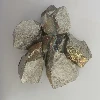
North Korean ferrosilicon (FeSi) has historically held a niche yet significant position in the global metallurgical market. Among its product range, FeSi 68-signifying an alloy with approximately 68% silicon content, with the remainder primarily iron-stands out as a workhorse grade. While the nation's industry faces well-documented challenges related to international sanctions, aging infrastructure, and inconsistent power supply, FeSi 68 from North Korea has been sought after for specific applications due to its cost competitiveness in certain markets. Understanding the common uses of FeSi 68 requires delving into its core metallurgical functions and the industries that depend on these properties.
The Foundry Industry: Deoxidizing and Inoculating with FeSi 68
A primary and universal application for FeSi 68 is in the foundry sector for the production of cast iron and steel. Here, FeSi 68 performs two critical functions. First, it is a powerful deoxidizer. During the melting and pouring process, molten iron readily absorbs oxygen from the air, which can lead to porosity and weakened final castings. Adding FeSi 68 introduces silicon, which has a high affinity for oxygen. It reacts to form silica (SiO2) slag that floats to the surface, effectively "killing" the steel or iron by removing dissolved oxygen, resulting in a cleaner, denser metal. Second, in gray iron castings, FeSi 68 acts as an inoculant. The silicon in FeSi 68 promotes the formation of graphite flakes in a controlled manner, which is essential for achieving the desired mechanical properties, such as machinability, vibration damping, and thermal conductivity. The consistent silicon input from a grade like FeSi 68 is crucial for predictable and reliable casting outcomes. For North Korean producers, supplying FeSi 68 to foundries, particularly in regional markets, has been a traditional application, where the alloy's core chemical function is paramount.
Steelmaking: A Core Deoxidizer and Alloying Agent
The steel industry is the largest consumer of ferrosilicon globally, and FeSi 68 plays a vital role, especially in basic oxygen and electric arc furnace operations. Similar to its use in foundries, the deoxidizing power of FeSi 68 is indispensable here. Producing high-quality, defect-free steel requires the thorough removal of oxygen, and FeSi 68 is a standard choice for this final deoxidation stage (often used in conjunction with other elements like aluminum). Beyond deoxidation, FeSi 68 serves as a precise alloying additive. The silicon from FeSi 68 dissolves into the molten steel, permanently enhancing its properties. Silicon increases the steel's strength and hardness without a proportionate loss of ductility. It significantly improves electrical resistivity, making silicon steel (often produced with grades like FeSi 68) essential for transformer cores and electric motor laminations. Furthermore, silicon enhances oxidation resistance at high temperatures. For bulk steel production, the cost-effectiveness of the alloy source is a major consideration. Historically, North Korean FeSi 68 has been positioned as a lower-cost feedstock for certain steel mills, particularly in Asia, seeking to manage raw material expenses, though this trade is now severely constrained.
Production of Magnesium: The Pidgeon Process and FeSi 68
One of the most specific and chemically demanding applications for FeSi 68 is in the production of magnesium metal via the silicothermic reduction process, commonly known as the Pidgeon process. In this method, calcined dolomite (a mixture of calcium and magnesium oxides) is mixed with finely ground FeSi 68 and pressed into briquettes. These briquettes are heated under high vacuum in retorts. At elevated temperatures (around 1200°C), the silicon from the FeSi 68 acts as a reducing agent, stripping oxygen from the magnesium oxide. The magnesium vapor produced then condenses into crystalline metal. The efficiency of this reaction is highly dependent on the grade and purity of the ferrosilicon used. FeSi 68 is often preferred over higher-silicon grades for this application because its specific silicon content and lower levels of impurities like aluminum and calcium can offer an optimal balance of reductant power, reaction kinetics, and cost. North Korea possesses both dolomite reserves and ferrosilicon production capacity, making FeSi 68 a strategically important intermediate product for potential domestic magnesium production or for export to magnesium producers. The specifications for FeSi 68 in this application are typically stringent, focusing on particle size and trace element control.
Manufacturing of Other Silicon-Containing Alloys and Metals
FeSi 68 often serves as a master alloy or a raw material input in the production of other silicon-bearing metals and ferroalloys. For instance, it can be used in the manufacture of silicon metal itself through further refinement processes. More commonly, FeSi 68 is a key charge material in the production of specialized ferroalloys like ferro silicon magnesium (FeSiMg) for ductile iron production, or calcium silicon (CaSi) for advanced steel refining. In these processes, FeSi 68 provides the reliable silicon base to which other elements (magnesium, calcium) are added. Using a standardized grade like FeSi 68 allows secondary alloy producers to calculate their feedstock blends with greater accuracy, ensuring the final product meets precise compositional standards. For North Korean industry, the ability to supply FeSi 68 for these downstream alloy sectors would represent a move up the value chain, though such advanced manufacturing has likely been limited by technology and investment.
The Impact of Sanctions and Market Realities on North Korean FeSi 68 Applications
It is impossible to discuss the applications of North Korean FeSi 68 without addressing the profound impact of international sanctions, particularly those imposed by the UN Security Council. Resolutions since 2016 have explicitly banned the export of North Korean metals, including ferrosilicon. This has effectively severed its legal access to the vast majority of the global applications described above. The traditional markets in foundries and steel mills are now legally off-limits for new contracts. Therefore, while the inherent technical applications for a material like FeSi 68 remain unchanged, the practical, current application of North Korean-origin FeSi 68 is largely confined to:
Domestic Use: Any ongoing North Korean steel, foundry, or potential magnesium production would consume FeSi 68 internally.
Illicit Shipments: There is evidence of attempts to circumvent sanctions through ship-to-ship transfers and falsified documentation. In such cases, the FeSi 68 would ultimately be used for the standard industrial purposes, but its origin would be obscured.
The sanctions have redirected discussion from the metallurgical properties of FeSi 68 to one of supply chain due diligence, as reputable end-users must now rigorously verify the provenance of their ferroalloy feedstock to avoid legal and reputational risk.
Conclusion
In summary, FeSi 68 is a versatile and fundamental ferroalloy whose applications are defined by its high silicon content. From deoxidizing steel and inoculating cast iron to enabling the production of magnesium and specialized alloys, FeSi 68 is a cornerstone of metallurgy. Historically, North Korean FeSi 68 found its place in these global industries primarily on a cost-competitive basis. Today, however, its practical flow into these common applications is critically limited by geopolitical constraints rather than technical suitability. The knowledge of what FeSi 68 does remains essential for industry professionals, who must now couple that with heightened awareness of where their FeSi 68, and all raw materials, originate.