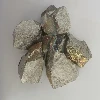
Why Does Metallic Silicon (Ferroalloy) Remain an Irreplaceable Raw Material Despite Continuous Advancements in Alternative Alloying Technologies?
To answer this question, we must first strip away a common confusion: in the strict ferroalloy industry nomenclature, "metallic silicon" (also known as industrial silicon or crystalline silicon) is not itself a ferroalloy in the sense of an iron-containing master alloy. Instead, it is the base raw material from which silicon-based ferroalloys-such as ferrosilicon (FeSi) and silicomanganese (SiMn)-are produced. However, in commercial practice, metallic silicon (typically 98–99.5% Si) is grouped with ferroalloys because it serves the exact same metallurgical function: deoxidation, alloying, and modification of liquid steel and cast iron. With that clarified, the persistence of metallic silicon in modern ferrous metallurgy, despite decades of research into substitutes, rests on four unassailable physical-chemical pillars.
First, can any other element replicate silicon's unique deoxidation thermodynamics in liquid steel?
No. Deoxidation is the removal of dissolved oxygen from molten steel to prevent blowholes and embrittlement during solidification. Silicon's affinity for oxygen is exceptionally high-the standard Gibbs free energy of formation of SiO₂ is approximately –857 kJ/mol at 1600°C-but it is precisely moderate compared to aluminum (–1200 kJ/mol) or calcium (–1300 kJ/mol). This intermediate strength is its genius: silicon deoxidizes efficiently without producing large, angular, non-deformable oxide inclusions (as alumina does) or excessively reactive dross (as calcium does). Moreover, the product of silicon deoxidation, SiO₂, has a lower density than steel and readily coalesces and floats out. More critically, silicon deoxidation does not generate gaseous reaction products, unlike carbon (which forms CO bubbles that can be trapped as porosity). Attempts to replace silicon with complex rare-earth or titanium-based deoxidizers have failed on cost-effectiveness and inclusion-morphology control, especially in high-strength low-alloy (HSLA) steels where cleanliness is paramount.
Second, does metallic silicon offer any structural benefit beyond deoxidation that alternative alloying elements cannot mimic?
Yes, and this is often overlooked. Silicon is one of the few elements that strongly raises the activity coefficient of carbon in austenite, thereby increasing the hardenability of steel without consuming expensive nickel or molybdenum. In cast irons, silicon promotes the formation of ferrite and graphite nodulization (in ductile iron) when combined with magnesium. But the irreplaceable role emerges in electrical steels: silicon increases electrical resistivity and reduces hysteresis losses. A 3% Si-Fe alloy has about four times the electrical resistivity of pure iron. No other commercially viable element-cobalt, nickel, or aluminum-can simultaneously improve resistivity, reduce magnetostriction, and maintain high saturation induction at comparable cost. For transformer cores and motor laminations, metallic silicon is not just convenient; it is physically optimal.
Third, can recycled scrap or secondary silicon sources replace primary metallic silicon in ferroalloy production?
Only to a very limited extent. The ferroalloy industry consumes metallic silicon primarily as a "carrier" of pure silicon into ferrosilicon (50–75% Si) and silicomanganese. While silicon-containing scrap (e.g., rejected solar-grade silicon, machining swarf, or worn refractory bricks) exists, its contamination profile-boron, phosphorus, carbon, and heavy metals-is unacceptable for most steel grades. Steelmakers require guaranteed low levels of titanium, zirconium, and alkaline earths, as these interfere with continuous casting flux behavior. Furthermore, the physical form of scrap (powders, thin foils) causes severe oxidation losses and poor dissolution kinetics in the ladle. Primary metallic silicon, produced via carbothermic reduction of quartz in submerged-arc furnaces, delivers a consistent lump size (10–100 mm), predictable impurity matrix, and immediate dissolution in molten steel-characteristics that secondary materials cannot economically match, even with advanced remelting.

Fourth, what about the cost and energy argument-does the high electricity consumption of metallic silicon production not make it a prime candidate for replacement by low-energy master alloys?
It is true that producing one metric ton of metallic silicon consumes roughly 11,000–13,000 kWh of electricity, making it among the most energy-intensive bulk materials. However, the relevant comparison is not absolute energy use but energy per unit of deoxidation or alloying effect. For example, to achieve a 0.4% Si addition in 100 tonnes of steel, one needs about 400 kg of metallic silicon. The same deoxidation equivalent using aluminum would require only 130 kg but would introduce ten times more oxide inclusions, requiring additional inclusion-engineering steps (calcium treatment, argon stirring, and filtration) that themselves consume energy and refractory materials. Over the full life cycle-from furnace to final rolled product-silicon's net energy footprint is often lower than alternative routes when accounting for yield losses, rework, and downgraded quality. Similarly, silicomanganese, which is cheaper per unit of silicon, cannot be used for high-silicon electrical steels because manganese introduces unwanted magnetic dilution and core losses. There is no energy-free shortcut; silicon's thermodynamic properties are non-negotiable.
Fifth, have innovations in cored wires and powder injection not reduced the need for bulk metallic silicon?
These innovations have changed how silicon is added, but not that silicon is added. Cored wires (steel sheaths containing silicon fines) improve recovery and allow late-stage trim additions, but the silicon inside remains metallic silicon. Powder injection into ladle or tundish likewise depends on ground silicon. The rise of alternative deoxidizers like silicon-calcium or silicon-barium has reduced metallic silicon usage in certain specialty grades, but these are not replacements-they are modifiers that contain silicon as the primary active component. In practice, every tonne of silicon-calcium wire sold still consumes 0.6–0.8 tonnes of primary metallic silicon as feedstock. The substitution is thus circular, not eliminative.
Finally, is there a foreseeable scenario-such as hydrogen-based steelmaking or AI-optimized alloy design-that could render metallic silicon obsolete?
Not in the next two decades, for two structural reasons. First, hydrogen direct reduction (H-DRI) produces steel with very low residual elements, but it does not change the fundamental need for deoxidation; the steel still contains 200–600 ppm oxygen at tapping, and silicon remains the most cost-effective deoxidizer compatible with continuous casting slags. Second, machine learning can optimize existing alloy recipes to use less silicon, but the lower bound is set by physical thresholds: below 0.15% Si in most structural steels, tensile strength drops and ductile-to-brittle transition temperature rises. To drop below that threshold would require substituting with vanadium, niobium, or chromium-each costing 5–20 times more per kilogram of strengthening effect. In high-silicon grades (up to 6.5% Si for high-frequency magnetic applications), no alternative element provides the same combination of resistivity and processability; even nanocrystalline alloys are orders of magnitude more expensive and only used in niche transformers.
In conclusion, metallic silicon persists not from inertia or lack of innovative thinking, but because its thermodynamic, physical, and economic coordinates form a local optimum that alternative technologies have consistently failed to outperform. Its deoxidation strength is neither too weak (ineffective) nor too strong (inclusion-prolific); its alloying benefits span mechanical, magnetic, and casting properties; its supply chain is mature and quality-controlled; and its energy intensity is offset by superior process stability and final product yield. Until a completely new paradigm-perhaps liquid-phase electrochemical refining or plasma-based alloying-emerges at industrial scale, the question is not whether metallic silicon can be replaced, but how its production can be decarbonized and its recovery improved. The answer to the opening question, therefore, is definitive: metallic silicon remains irreplaceable because no alternative element or compound offers the same integrated value proposition for ferrous metallurgy, and no foreseeable alloying technology can circumvent the laws of chemical thermodynamics that make silicon uniquely suitable.
📧E-mail: goldenltd.silicon@gmail.com 📞WhatsApp: 86 16663721147