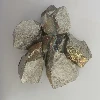
Choosing the Right Inoculant: When to Use Ferro Silicon Barium Over FeSi
Introduction: The Art and Science of Inoculation in Casting
In the world of cast iron production, success doesn't just depend on melting and pouring metal; it hinges on control at the microscopic level. One of the key steps that ensures the desired microstructure is inoculation – a precise addition of elements to control graphite formation and eliminate chill.
When I first started in this industry, choosing an inoculant felt like choosing coffee: you know you need it, but the options can be overwhelming. Among the most common choices are Ferro Silicon (FeSi) and its enhanced cousin Ferro Silicon Barium (FeSiBa). Both do the job, but the difference in performance can be significant – especially when your customer demands high-quality, consistent castings.
So, how do you decide which one to use? Let's explore the science, practical experience, and industry insights to help you make the right call.
Why Inoculation Matters So Much
Before diving into the differences, let's talk about why inoculation is critical:
- Prevents Chill: Avoids the formation of hard carbides in thin sections.
- Controls Graphite Shape: Ensures uniform graphite distribution for better mechanical properties.
- Improves Machinability: Softer structures reduce tool wear and machining costs.
- Reduces Shrinkage: Promotes uniform solidification.
Without proper inoculation, you risk casting defects, rework, and unhappy customers. Trust me, nothing ruins your day like a batch of defective cylinder heads because of poor inoculation control. 😅
Ferro Silicon (FeSi): The Traditional Workhorse
Ferro Silicon is the classic inoculant that's been around for decades. It's reliable, widely available, and gets the job done for most gray and ductile iron applications.
Why FeSi?
- Affordable & Accessible: Cost-effective solution for general casting needs.
- Standard Performance: Adequate for most thin-to-medium section castings.
- Ease of Use: Melts quickly and reacts predictably.
But as casting requirements have evolved – thinner walls, more complex geometries, tighter specifications – FeSi alone often falls short.
Enter Ferro Silicon Barium (FeSiBa): The Game Changer
The first time I used Ferro Silicon Barium, it was like upgrading from a basic smartphone to the latest flagship model. Suddenly, the problems that seemed unavoidable – chill, inconsistent graphite, late fading – were manageable.
So, what makes FeSiBa different?
🔹 Stronger Nucleation Effect: Barium enhances nucleation sites for graphite, giving you finer, more uniform structures.
🔹 Excellent Anti-Fading Property: Keeps inoculation effect active for a longer period compared to FeSi.
🔹 Chill Elimination: Superior in preventing carbides, especially in thin sections.
🔹 Lower Addition Rate: You often need less FeSiBa to achieve the same or better results than FeSi.
The Science Behind FeSiBa
Let's get into the why.
Barium's Role: Barium not only increases the number of nucleation sites but also modifies the shape and distribution of graphite. It prevents carbide formation, leading to softer and more machinable cast iron.
Synergy with Silicon: Silicon promotes graphitization, while barium adds stability and anti-fade properties.
Thermal Stability: FeSiBa maintains effectiveness even under prolonged holding times.
Practical Scenarios: When to Choose FeSiBa Over FeSi
From years on the shop floor, here are the situations where FeSiBa shines:
1. Thin-Walled Castings
If you're pouring thin-section components like automotive parts, FeSiBa is a lifesaver. It eliminates chill far better than FeSi.
2. Long Holding Times
Ever had an unexpected delay before pouring? FeSiBa's anti-fading property ensures your inoculation effect stays intact.
3. Complex Geometries
For intricate castings with varying section thicknesses, FeSiBa provides consistent graphite morphology throughout.
4. High-Quality Demands
If your customer needs excellent machinability and zero chill, don't gamble with FeSi – go with FeSiBa.
Comparing FeSi and FeSiBa: Key Differences
| Feature | Ferro Silicon (FeSi) | Ferro Silicon Barium (FeSiBa) |
|---|---|---|
| Anti-Fade Ability | Moderate | Excellent |
| Chill Prevention | Good | Superior |
| Graphite Distribution | Standard | Fine and Uniform |
| Addition Rate | Higher | Lower |
| Cost per Ton | Lower | Slightly Higher |
Industry Insights: The Trend Toward FeSiBa
In the last decade, the global casting industry has been shifting towards advanced inoculants. According to market reports:
📊 FeSiBa adoption is growing at 8% annually, driven by:
- Automotive lightweight components.
- Ductile iron pipes with strict toughness requirements.
- High-performance machinery castings.
Companies that switched to FeSiBa report:
- Reduced scrap rates by up to 20%.
- Improved machining speeds by 15–25%.
Lessons Learned: Tips for Effective Use of FeSiBa
After years of trials and errors, here are my top recommendations:
🔹 1. Control Your Addition Point
Add FeSiBa as late as possible, ideally in the stream or ladle, to maximize effectiveness.
🔹 2. Don't Overdose
More isn't always better. Stick to the recommended dosage, usually lower than FeSi.
🔹 3. Monitor Fading
Even though FeSiBa has excellent anti-fade properties, always pour within optimal time limits.
🔹 4. Pair with Good Practice
Inoculation won't fix bad melting practices. Control sulfur and oxygen levels for best results.
Cost-Benefit Analysis: Is FeSiBa Worth It?
At first glance, FeSiBa seems pricier than FeSi. But factor in:
- Lower addition rate.
- Reduced scrap and rework.
- Better machining.
When you crunch the numbers, FeSiBa often delivers a net cost saving of 5–10% per ton of good castings.
Final Thoughts: Making the Right Choice
Choosing between FeSi and FeSiBa isn't just about cost – it's about quality, consistency, and customer satisfaction. In a competitive industry, these factors set you apart.
Whenever I see a perfectly machined ductile iron part rolling off the line, I remember the role a few grams of inoculant played. Sometimes, the smallest additions make the biggest difference.
Henan Golden International Trade Company as ferro alloy supplier for more than 20 years, we have exported ferro alloys especially ferro silicon, silicon metal, LC FeCr, FeMn LC and MC, CARBON RAISER GPC/CPC, calcium silicon, Silicon carbide, FeSiBa inoculant, FeSiMg nodulizer and other raw materials to many countries and steel plants. If you want to know more about ferro alloys or are interested in purchasing it, you can send a massage to WhatsApp: +86 166 6835 7841. We will reply to you as soon as possible after we see the message.