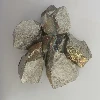
What is the Difference Between Ferro Silicon Lump, Granule, and Powder in Usage?
Introduction
Ferro Silicon (FeSi) is one of the most widely used ferroalloys in the steel and foundry industries. It acts as a deoxidizer, inoculant, and alloying agent, playing a critical role in improving the mechanical properties, structure, and quality of steel and cast iron. While Ferro Silicon can be produced in different grades (such as FeSi 72%, FeSi 75%), another important factor that significantly affects its application is particle size.
In commercial trade, Ferro Silicon is typically supplied in three major forms:
Lump
Granule
Powder
Although the chemical composition may be similar, the physical form determines how the material is added to the process, how efficiently it reacts, and what end results it produces. This article explores in detail the differences between Ferro Silicon lump, granule, and powder in terms of usage, advantages, and application scenarios.
1. What is Ferro Silicon Lump?
Definition
Ferro Silicon lump usually refers to pieces in the size range of 10–100 mm. It is produced by crushing and screening the ferro silicon ingot into larger chunks suitable for furnace charging.
Usage
Steelmaking: Added directly into the electric arc furnace (EAF) or basic oxygen furnace (BOF) as a deoxidizer during the tapping process.
Casting: Used in cupola or large-scale foundries where slower dissolution and gradual release of silicon is required.
Alloying: Provides stable silicon recovery when larger doses of silicon are required.
Advantages
Slower dissolution rate – prevents sudden violent reactions.
Cost efficiency – lower production and handling costs compared to finely crushed products.
Convenient for bulk feeding – suitable for steel mills with continuous and large-scale consumption.
Limitations
Less uniform distribution in molten metal compared to finer sizes.
Not suitable for precise control of silicon addition.
2. What is Ferro Silicon Granule?
Definition
Granules are medium-sized particles, typically 3–10 mm. They are obtained by screening ferro silicon after crushing, to achieve a uniform intermediate size distribution.
Usage
Steel refining (Ladle metallurgy): Granules are added during secondary metallurgy (ladle furnace, vacuum refining) where controlled deoxidation is required.
Foundries: Used as inoculants in gray and ductile iron production.
Cored wire manufacturing: Sometimes used as feed material for cored wire production.
Advantages
Balanced dissolution rate – dissolves faster than lumps but not as aggressively as powder.
Better distribution – disperses more evenly in molten steel, ensuring uniform silicon content.
High recovery rate – less wastage and oxidation compared to large lumps.
Limitations
Slightly higher cost due to screening and size control.
Requires more precise handling than lumps.
3. What is Ferro Silicon Powder?
Definition
Powdered Ferro Silicon generally refers to fine particles (<3 mm, sometimes even <75 microns). It is produced by milling or fine crushing.
Usage
Steelmaking: Added during final deoxidation in ladle or tundish.
Iron casting: Used as inoculant to promote graphite nucleation in ductile iron and gray iron.
Welding electrodes: As a raw material in electrode coating to provide silicon during welding.
Magnesium production: Ferro Silicon powder mixed with dolomite is used in the Pidgeon process for magnesium metal production.
Heavy media separation: Ferro Silicon powder (15–75 micron) is widely used in mineral processing for density separation.
Advantages
Very fast dissolution rate – reacts quickly, ideal for fine-tuning chemistry.
Precise addition – allows accurate control of silicon recovery.
Specialized applications – essential for welding, magnesium smelting, and mineral separation.
Limitations
Higher cost due to fine grinding.
Storage and handling require care to prevent oxidation and dust pollution.
Not economical for bulk deoxidation compared to lump or granule.

4. Comparative Analysis
| Form | Size Range | Main Usage | Advantages | Limitations |
|---|---|---|---|---|
| Lump | 10–100 mm | Furnace deoxidation, bulk alloying | Low cost, bulk feeding, stable reaction | Uneven distribution, less precise |
| Granule | 3–10 mm | Ladle metallurgy, inoculation | Balanced reaction, high recovery, good distribution | Slightly higher cost |
| Powder | <3 mm (down to microns) | Precise deoxidation, inoculant, welding, magnesium smelting, mineral separation | Fast reaction, precise dosing, specialized uses | High cost, storage issues, dust |
5. Key Factors Influencing Usage
Steelmaking vs Foundry – Steel mills often prefer lumps and granules, while foundries and welding industries prefer powder.
Reaction rate requirements – Faster dissolution requires smaller particle sizes.
Cost efficiency – Bulk consumers often prioritize lumps for economy, while high-value casting industries prioritize granules/powder.
Process control – Secondary metallurgy requires granules/powder for precision.
Special industries – Powder has unique applications in welding, magnesium, and mineral separation, where lumps/granules cannot substitute.
6. Practical Examples
Large steel mill in Korea: Uses FeSi lumps (10–50 mm) during tapping in BOF to achieve basic deoxidation.
Foundry in India: Uses FeSi granules (3–8 mm) as inoculants for ductile iron, ensuring uniform graphite spheroidization.
Electrode manufacturer in Europe: Uses FeSi powder (<75 micron) in welding electrode coatings.
Magnesium plant in China: Consumes FeSi powder as reducing agent in the Pidgeon process.
Mining company in South Africa: Uses FeSi fine powder for heavy media separation in diamond ore processing.
7. Market Perspective
The choice of particle size also impacts the market price and logistics:
Lumps: Lowest price, lowest handling cost.
Granules: Moderate price due to screening.
Powder: Highest price, plus additional handling and packaging requirements (bags, liners).
With the growing emphasis on energy efficiency and precise metallurgy, the demand for granules and powder is steadily increasing, although lumps remain dominant in bulk steelmaking.
Conclusion
While all three forms-lump, granule, and powder-belong to the same alloy family, their applications differ greatly depending on particle size.
Lump Ferro Silicon: Ideal for bulk deoxidation and alloying in large-scale steelmaking.
Granule Ferro Silicon: Balances efficiency and precision, widely used in ladle metallurgy and foundries.
Powder Ferro Silicon: Best for specialized applications requiring rapid reaction or precise chemistry, as well as non-metallurgical industries like welding and mineral processing.
Ultimately, the choice depends on process requirements, cost considerations, and quality standards. For a supplier, it is essential to provide flexible size options to meet the diverse needs of steel mills, foundries, and other industries.
📧 E-mail: goldenltd.silicon@gmail.com
📞 WhatsApp: 86 16663721147