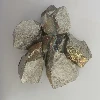
In the relentless pursuit of higher efficiency, higher frequency, and higher temperature operation in power electronics, traditional silicon-based materials are approaching their physical limits. Silicon carbide, a standout third-generation semiconductor material, is positioned at the forefront of potentially replacing silicon, thanks to its unique wide bandgap properties. With a bandgap three times wider than silicon's, a breakdown electric field ten times stronger, and thermal conductivity more than three times higher, SiC-based power devices can withstand higher voltages, switch faster, exhibit lower on-resistance, and dissipate heat far more effectively. From traction inverters in electric vehicles to power supplies in 5G base stations, SiC is moving from a "lab star" to an "industrial workhorse." Its potential has already been validated in mass-produced models like the Tesla Model 3.
However, for SiC to truly become the "ultimate material," two significant challenges remain. First, manufacturing SiC substrates and epitaxial wafers is exceptionally difficult. The crystal growth requires extremely high temperatures and slow rates, while controlling defects remains a major hurdle, making SiC wafers far more expensive than silicon ones. Second, subsequent processing steps like dicing, grinding, and etching are challenging due to SiC's extreme hardness and chemical inertness, requiring specialized equipment and processes that impact yield. These factors directly drive up the cost of SiC devices. Consequently, in many cost-sensitive applications (such as consumer power supplies or home appliances), traditional silicon still dominates. For now, the adoption of SiC is largely concentrated in high-end, "performance-over-cost" applications.
Looking ahead, SiC's fate depends on the maturity and pace of innovation within its industrial chain. On one hand, as 6-inch and 8-inch wafer production lines scale up and growth processes are optimized, substrate costs are expected to drop significantly over the next five years. On the other hand, driven by massive markets like electric vehicles, photovoltaic energy storage, and industrial power supplies, leading companies are accelerating vertical integration and technological iteration. It is foreseeable that once SiC's cost falls below a critical threshold, it will become the default choice in high-voltage, high-frequency scenarios, rather than just an alternative. But to challenge the limits of ultra-high voltage (e.g., above 10kV) or ultra-high frequency, other materials like gallium nitride (GaN) or even diamond may compete or complement it. Thus, while SiC may not be the final answer, it is arguably the most solid stepping stone toward the next generation of power electronics architectures.