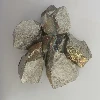
Incoulant BaCaSi-short for Barium-Calcium-Silicon inoculant-is an advanced master alloy primarily used in the foundry and steelmaking industries. While traditional silicon-based inoculants focus on graphite nucleation and chill reduction, BaCaSi offers a unique synergy of three active elements: barium (Ba), calcium (Ca), and silicon (Si). This combination significantly enhances the modification of non-metallic inclusions, refines as-cast grain structures, and improves the mechanical properties of ductile cast iron and specialty steels.
The primary advantage of BaCaSi lies in its powerful deoxidizing and desulfurizing capabilities. Barium, being heavier and less volatile than calcium, prolongs the reaction time in molten metal, allowing for deeper penetration of inoculating effects. This leads to a substantial reduction in chilling tendency and carbide formation in thin-walled castings. Meanwhile, calcium acts as a strong deoxidizer and sulfide shape controller, transforming harmful elongated manganese sulfides into harmless globular or blocky ones, which boosts impact toughness and machinability.

In nodular cast iron production, BaCaSi inoculants produce a higher nodule count and more uniform graphite distribution compared to standard FeSi or CaSi inoculants. The result is improved tensile strength, elongation, and reduced shrinkage porosity. For steel refining, BaCaSi helps achieve cleaner steels by promoting the formation of low-melting-point calcium aluminates, which float out easily, and by reducing reoxidation during continuous casting.
Industrial trials have demonstrated that BaCaSi outperforms conventional inoculants in fading resistance-the gradual loss of inoculation effect over time. This makes it particularly suitable for large foundries with longer pouring cycles or automated molding lines. However, strict control of Ba and Ca ratios is critical; excessive barium may cause ferrite stabilization issues, while too much calcium can lead to slag formation.
As the industry pushes for lighter, stronger, and more fatigue-resistant metal components, incoulant BaCaSi represents a promising evolution in process metallurgy. With ongoing research into nanoparticle-enhanced versions, it could well become a standard tool for high-performance casting and clean steel production in the coming decade.